

What Animals Are Only Alive In Captivity
| Conservation status by IUCN Red List category | |
|---|---|
 | |
| Extinct | |
|
|
| Threatened | |
|
|
| Lower Risk | |
|
|
| Other categories | |
|
|
| Related topics
| |
 Comparing of Red list classes above and NatureServe status beneath  | |

The ʻalalā has been listed as extinct in the wild since 2004
A species that is extinct in the wild (EW) is one that has been categorized by the International Union for Conservation of Nature equally known just by living members kept in captivity or equally a naturalized population exterior its celebrated range due to massive habitat loss.[i]
Examples [edit]

The scimitar oryx (Oryx dammah) is an example of a species which is extinct in the wild.
Examples of species and subspecies that are extinct in the wild include:
- Alagoas curassow (last unconfirmed sighting reported in the late 1980s, listed extinct in the wild since 1994)[ii]
- Beloribitsa[3]
- Cachorrito de charco palmal (final seen in 1994, listed extinct in the wild since 1996)[4]
- Escarpment cycad (listed extinct in the wild since 2006)[five]
- Franklinia (last seen in 1803, listed extinct in the wild since 1998)[6]
- Golden skiffia (listed extinct in the wild since 1996)[7]
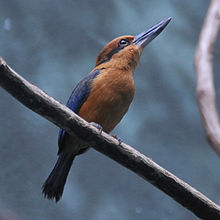
- Guam kingfisher (listed extinct in the wild since 1986)[8]
- Hawaiian crow or ʻalalā (terminal seen in 2002, listed as extinct in the wild since 2004)[9] Small groups take since been released in 2017[10] [xi] and 2018.[12]
- Kihansi spray toad (listed extinct in the wild since 2009)[13]
- Northern white rhinoceros (possibly extinct in the wild)[14]
- Oahu deceptor bush-league cricket (listed extinct in the wild since 1996)[15]
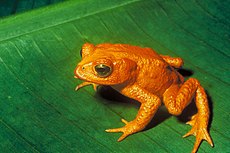
- Panamanian golden frog (perchance extinct in the wild)[16]
- Père David's deer (listed extinct in the wild since 2008.[17] However, reintroduction from captive populations began in 1985, with 53 wild herds of varying sizes being recorded in 2003)[eighteen]
- Scimitar oryx (listed extinct in the wild since 2000.[19] A herd of 21 was successfully released into the wild in Chad in 2016, producing the first offspring born in the wild in over 20 years in 2017)[20]
- Socorro dove (listed extinct in the wild since 1994)[21]
- Socorro isopod (last seen in 1988, listed as extinct in the wild since Baronial 1996)[22]
- South China tiger (since 2008 IUCN Red List lists every bit critically endangered; possibly extinct in the wild)[23] [24]
- Spix'south macaw (listed extinct in the wild since June 2019)[25]
- Wyoming toad (listed extinct in the wild since 1991, although 853 accept been released into the wild since 1995, leading to a population of around 1,500 in 2017)[26]
The Pinta Island tortoise (Geochelone nigra abingdoni) had only one living private, named Lonesome George, until his death in June 2012.[27] The tortoise was believed to be extinct in the mid-20th century, until Hungarian malacologist József Vágvölgyi spotted Lonesome George on the Galapagos isle of Pinta on 1 December 1971. Since then, Lonesome George has been a powerful symbol for conservation efforts in full general and for the Galapagos Islands in particular.[28] With his death on 24 June 2012, the subspecies is again believed to be extinct.[29] With the discovery of 17 hybrid Pinta tortoises located at nearby Wolf Volcano a plan has been made to attempt to breed the subspecies back into a pure state.[30]
Not all EW species are rare. An example is the Brugmansia family, where all seven species are widely cultivated but none are establish in the wild.[31] Ultimately, the purpose of preserving biodiversity is to maintain ecological function so when a species exists only in captivity, it is ecologically extinct.
Reintroduction [edit]
Reintroduction is the deliberate release of individuals into the wild, from captivity or from other areas where the species survives. Yet, information technology may exist difficult to reintroduce EW species into the wild, fifty-fifty if their natural habitats were restored, because survival techniques, which are often passed from parents to offspring during parenting, may accept been lost.
An example of a successful reintroduction of a formerly EW species is Przewalski'southward horse, which every bit of 2018 is considered to be an endangered species, post-obit reintroduction started in the 1990s.[32]
Another successful example is the Arabian Oryx, at present considered vulnerable just not EW.
Run into also [edit]
- IUCN Red List extinct in the wild species for a list by taxonomy
- Category:IUCN Red List extinct in the wild species for an alphabetical list
- Extinction
- Local extinction
- Lists of extinct species
References [edit]
- ^ "2001 IUCN Red List Categories and Criteria: Version three.1" (PDF). IUCN. p. 14. Archived from the original (PDF) on 21 June 2010. Retrieved 30 May 2010.
- ^ "Alagoas Curassow (Mitu mitu)". IUCN Ruby Listing of Threatened Species. vii August 2018. 7 August 2018.
- ^ Freyhof, J.; Kottelat, Yard. (2008). "Stenodus leucichthys". IUCN Ruddy List of Threatened Species. 2008: e.T20745A9229071. doi:x.2305/IUCN.UK.2008.RLTS.T20745A9229071.en.
- ^ "La Palma Pupfish (Cyprinodon longidorsalis)". IUCN Carmine List of Threatened Species. 27 September 2018. 27 September 2018.
- ^ Donaldson, J.S. (2010). "Encephalartos brevifoliolatus". IUCN Red List of Threatened Species. 2010: e.T41882A10566751. doi:10.2305/IUCN.Uk.2010-3.RLTS.T41882A10566751.en. [ permanent dead link ]
- ^ "Franklin Tree (Franklinia alatamaha)". IUCN Scarlet Listing of Threatened Species. three February 2015. three Feb 2015.
- ^ "Gold Skiffia (Skiffia francesae)". IUCN Red List of Threatened Species. 18 April 2018. eighteen April 2018.
- ^ "Guam Kingfisher (Todiramphus cinnamominus)". IUCN Red List of Threatened Species. Oct 2016. October 2016.
- ^ "Hawaiian Crow (Corvus hawaiiensis)". IUCN Carmine List of Threatened Species. Oct 2016. Oct 2016.
- ^ "'ALALĀ RELEASED INTO NATURAL AREA RESERVE". Aliso Laguna News.
- ^ "Rare Hawaiian crows released into native forests of Hawai'i Island". KITV4. Archived from the original on 24 Oct 2021. Retrieved ten February 2020.
- ^ "Five more alala released into Puu Makaala Forest Reserve". W Hawaii Today. October 2018.
- ^ "Nectophrynoides asperginis". IUCN Reddish List of Threatened Species. 25 July 2014. 25 July 2014.
- ^ Emslie, R. (2020). "Ceratotherium simum ssp. cottoni". IUCN Red Listing of Threatened Species. 2020: e.T4183A45813838. doi:ten.2305/IUCN.United kingdom.2020-i.RLTS.T4183A45813838.en . Retrieved 13 November 2021.
- ^ "Leptogryllus deceptor". IUCN Red List of Threatened Species. August 1996. Baronial 1996.
- ^ "'Last wave' for wild golden frog". BBC. 2 February 2008. Retrieved 22 Feb 2015.
- ^ "Père David's Deer (Elaphurus davidianus)". IUCN Ruddy Listing of Threatened Species. 31 March 2016. 31 March 2016.
- ^ Yang, R., Zhang, L., Tan, B. and Zhong, Z. 2003. Investigation on the status of Père David's deer in Cathay. Chinese Journal of Zoology 38: 76~81.
- ^ "Scimitar-horned Oryx (Oryx dammah)". IUCN Red List of Threatened Species. 27 April 2016. 27 Apr 2016.
- ^ "Scimitar-horned oryx returns to Sahara". Zoological Society of London.
- ^ "Zenaida graysoni (Socorro Pigeon)". IUCN Cherry List of Threatened Species. October 2016. Oct 2016.
- ^ "Thermosphaeroma thermophilum". IUCN Blood-red List of Threatened Species. August 1996. August 1996.
- ^ "South Cathay Tiger". Globe Wide Fund for Nature.
- ^ "Panthera tigris amoyensis". IUCN Cherry List of Threatened Species. 30 June 2008. 30 June 2008.
- ^ "Spix'south Macaw". IUCN Scarlet Listing of Threatened Species. 20 June 2019. twenty June 2019.
- ^ "Wyoming Toads Begin To Recover As States Seek Endangered Species Deed Overhaul". NPR.
- ^ Gardner, Simon (6 February 2001). "Lonesome George faces own Galapagos tortoise expletive". Archived from the original on 4 June 2011.
- ^ Nicholls, H. (2006). Lonesome George: The Life and Loves of a Conservation Icon. London, England: Macmillan Science. ISBNone-4039-4576-4. Archived from the original on 14 September 2011. Retrieved 28 April 2011.
- ^ "Last Pinta behemothic tortoise Lonesome George dies". BBC News. 24 June 2012. Retrieved 25 June 2012.
- ^ "Scientists: Extinct Galapagos tortoise species could be resurrected". CTV News. 22 Nov 2012. Retrieved 25 November 2012.
- ^ Petruzzello, Melissa. "Extinct in the Wild simply Still Effectually: 5 Plants and Animals Kept Alive by Humans". ENCYCLOPÆDIA BRITANNICA. ENCYCLOPÆDIA BRITANNICA. Retrieved 16 Nov 2019.
- ^ "An boggling render from the brink of extinction for worlds last wild equus caballus". nineteen December 2005. Archived from the original on 12 February 2012. Retrieved 5 March 2018.
External links [edit]
- Listing of Extinct in the Wild species as identified by the IUCN Red Listing of Threatened Species
Source: https://en.wikipedia.org/wiki/Extinct_in_the_wild
Posted by: livingstoneful1977.blogspot.com
0 Response to "What Animals Are Only Alive In Captivity"
Post a Comment